Suppressed
evidence
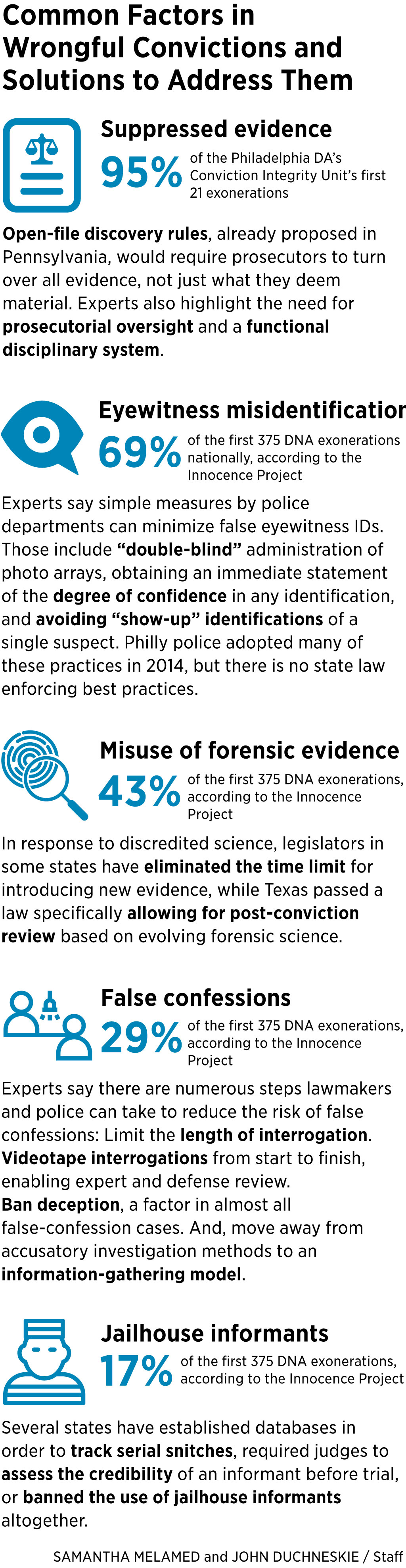
Open-file discovery rules, already proposed in Pennsylvania, would require prosecutors to turn over all evidence, not just what they deem material. Experts also highlight the need for prosecutorial oversight and a functional disciplinary system.
95%
of the Philadelphia DA’s Conviction Integrity Unit’s first 21 exonerations
Experts say simple measures by police departments can minimize false eyewitness IDs. Those include “double-blind” administration of photo arrays, obtaining an immediate statement of the degree of confidence in any identification, and avoiding “show-up” identifications of a single suspect. Philly police adopted many of these practices in 2014, but there is no state law enforcing best practices.
Eyewitness
misidentification
69%
of the first 375 DNA exonerations nationally, according to the Innocence Project
Misuse of forensic
evidence
In response to discredited science, legislators in some states have eliminated the time limit for introducing new evidence, while Texas passed a law specifically allowing for post-conviction review based on evolving forensic science.
43%
of the first 375 DNA exonerations, according to the Innocence Project
Experts say there are numerous steps lawmakers and police can take to reduce the risk of false confessions: Limit the length of interrogation. Videotape interrogations from start to finish, enabling expert and defense review. Ban deception, a factor in almost all false-confession cases. And, move away from accusatory investigation methods to an information-gathering model.
False
confessions
29%
of the first 375 DNA exonerations, according to the Innocence Project
Several states have established databases in order to track serial snitches, required judges to assess the credibility of an informant before trial, or banned the use of jailhouse informants altogether.
Jailhouse
informants
17%
of the first 375 DNA exonerations, according to the Innocence Project
SAMANTHA MELAMED and JOHN DUCHNESKIE / Staff

Suppressed evidence
of the Philadelphia DA’s Conviction Integrity Unit’s first 21 exonerations
95%
Open-file discovery rules, already proposed in Pennsylvania, would require prosecutors to turn over all evidence, not just what they deem material. Experts also highlight the need for prosecutorial oversight and a functional disciplinary system.
Eyewitness misidentification
69%
of the first 375 DNA exonerations nationally, according to the Innocence Project
Experts say simple measures by police departments can minimize false eyewitness IDs. Those include “double-blind” administration of photo arrays, obtaining an immediate statement of the degree of confidence in any identification, and avoiding “show-up” identifications of a single suspect. Philly police adopted many of these practices in 2014, but there is no state law enforcing best practices.
Misuse of forensic evidence
43%
of the first 375 DNA exonerations, according to the Innocence Project
In response to discredited science, legislators in some states have eliminated the time limit for introducing new evidence, while Texas passed a law specifically allowing for post-conviction review based on evolving forensic science.
False confessions
29%
of the first 375 DNA exonerations, according to the Innocence Project
Experts say there are numerous steps lawmakers and police can take to reduce the risk of false confessions: Limit the length of interrogation. Videotape interrogations from start to finish, enabling expert and defense review. Ban deception, a factor in almost all false-confession cases. And, move away from accusatory investigation methods to an information-gathering model.
Jailhouse informants
17%
of the first 375 DNA exonerations, according to the Innocence Project
Several states have established databases in order to track serial snitches, required judges to assess the credibility of an informant before trial, or banned the use of jailhouse informants altogether.

Suppressed evidence
of the Philadelphia DA’s Conviction Integrity Unit’s first 21 exonerations
95%
Open-file discovery rules, already proposed in Pennsylvania, would require prosecutors to turn over all evidence, not just what they deem material. Experts also highlight the need for prosecutorial oversight and a functional disciplinary system.
Eyewitness misidentification
69%
of the first 375 DNA exonerations nationally, according to the Innocence Project
Experts say simple measures by police departments can minimize false eyewitness IDs. Those include “double-blind” administration of photo arrays, obtaining an immediate statement of the degree of confidence in any identification, and avoiding “show-up” identifications of a single suspect. Philly police adopted many of these practices in 2014, but there is no state law enforcing best practices.
Misuse of forensic evidence
43%
of the first 375 DNA exonerations, according to the Innocence Project
In response to discredited science, legislators in some states have eliminated the time limit for introducing new evidence, while Texas passed a law specifically allowing for post-conviction review based on evolving forensic science.
False confessions
29%
of the first 375 DNA exonerations, according to the Innocence Project
Experts say there are numerous steps lawmakers and police can take to reduce the risk of false confessions: Limit the length of interrogation. Videotape interrogations from start to finish, enabling expert and defense review.
Ban deception, a factor in almost all false-confession cases. And, move away from accusatory investigation methods to an information-gathering model.
Jailhouse informants
17%
of the first 375 DNA exonerations, according to the Innocence Project
Several states have established databases in order to track serial snitches, required judges to assess the credibility of an informant before trial, or banned the use of jailhouse informants altogether.
SAMANTHA MELAMED and JOHN DUCHNESKIE / Staff